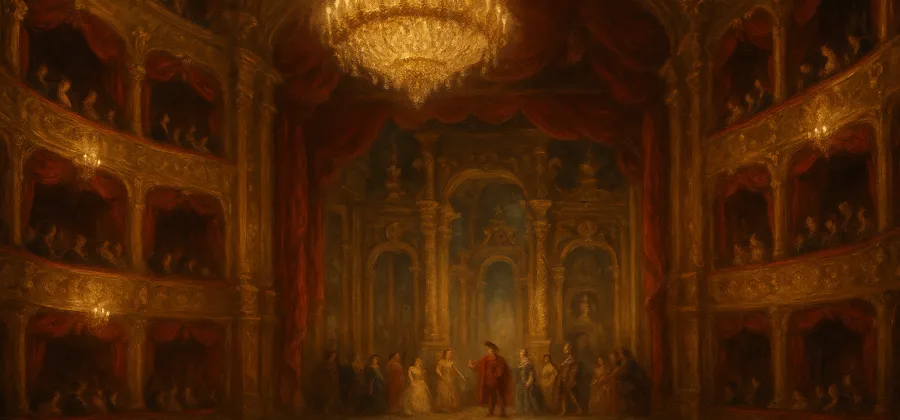
The Romantic era in music — roughly spanning from 1820 to 1900 — was a period of extraordinary creative ambition, when composers sought to express the full range of human emotion, to paint vivid landscapes in sound, and to forge deep connections between music, literature, and national identity. Tchaikovsky was at its heart.
What Was the Romantic Era?
The term "Romantic" in music refers not to romance in the everyday sense, but to a broader artistic philosophy rooted in feeling, imagination, and the expressive power of the individual artist. Romantic composers reacted against what they saw as the formal constraints of the Classical period (associated with Haydn, Mozart, and the early Beethoven), embracing larger orchestras, longer works, more complex harmonies, and a freer approach to musical form.
Programme Music
Music that tells a story or paints a picture — symphonic poems, overtures, tone poems. Think of Berlioz's Symphonie Fantastique or Tchaikovsky's Romeo & Juliet.
Expanded Orchestra
Romantic orchestras grew dramatically — more brass, expanded woodwinds, larger string sections, and new instruments including the tuba and bass clarinet.
Nationalism
Composers across Europe drew on folk melodies, legends, and national history to forge distinctive musical identities. In Russia, this gave rise to The Mighty Handful.
Emotional Expression
Personal emotion — melancholy, longing, ecstasy, tragedy — became legitimate and central to musical composition, not merely decoration.
Tchaikovsky's Contemporaries
To understand Tchaikovsky's place in music history, it helps to know the landscape he inhabited. The mid-to-late 19th century was a time of creative giants, fierce aesthetic debates, and competing schools of thought.
| Composer | Dates | Nationality | Relationship to Tchaikovsky |
|---|---|---|---|
| Johannes Brahms | 1833–1897 | German | Near-contemporary; champion of absolute music; Tchaikovsky admired but found overly academic |
| Richard Wagner | 1813–1883 | German | Hugely influential; Tchaikovsky respected his craft but resisted his total art-work ideology |
| Mily Balakirev | 1837–1910 | Russian | Leader of the nationalist Mighty Handful; early mentor who encouraged Romeo & Juliet |
| Modest Mussorgsky | 1839–1881 | Russian | Fellow Russian; nationalist; more radical harmonically; different aesthetic path |
| Nikolai Rimsky-Korsakov | 1844–1908 | Russian | Mighty Handful member; brilliant orchestrator; respectful but ideologically distinct relationship |
| Antonín Dvořák | 1841–1904 | Czech | Close contemporary; both navigated nationalism and European tradition; mutual admiration |
The Great Debate: Absolute vs. Programme Music
One of the defining arguments of the Romantic era was between those who believed music should be purely abstract (Brahms, Hanslick) and those who believed it should express specific ideas, emotions, or narratives (Liszt, Wagner, and to some extent Tchaikovsky). Tchaikovsky occupied a nuanced middle position — his symphonies often carried personal emotional programmes, but he rarely made these explicit.

The Mighty Handful vs. The Conservatory Tradition
The most distinctive tension in Russian Romantic music was between two competing visions of what Russian music should be. On one side stood The Mighty Handful (Moguchaya Kuchka) — Balakirev, Borodin, Cui, Mussorgsky, and Rimsky-Korsakov — who were largely self-taught and believed Russian music should break free from German academic formalism and root itself in folk melody and national character.
On the other stood the conservatory tradition, championed by Anton and Nikolai Rubinstein, which held that Russian composers needed rigorous European training to produce music of lasting quality. Tchaikovsky trained in this tradition but absorbed the nationalist spirit too — making him, in the eyes of many, the great synthesiser of the two Russian schools.
How to Listen to Romantic Music
If you are new to the Romantic era, a few pointers can dramatically enrich the listening experience:
- Follow the narrative: Many Romantic works have a story or emotional arc — let yourself be drawn into it.
- Listen for themes and their transformations: Romantic composers often return to the same melody in different moods, keys, or orchestrations. Notice how a theme changes as the work progresses.
- Pay attention to orchestral colour: Which instrument is carrying the melody? How does the texture change between a solo violin and the full orchestra?
- Don't worry about music theory: You don't need to understand harmony or form to experience great music. Your emotional response is valid and real.
- Use a listening guide: Our Listening Guides section offers curated introductions to Tchaikovsky's major works.
Begin Here
Piano Concerto No. 1, the Fifth Symphony, and Romeo & Juliet are ideal first encounters with the Romantic style.
Then Explore
Move to the Sixth Symphony, Eugene Onegin, and the ballet scores for greater depth and complexity.
Wider Context
Explore Brahms' symphonies, Dvořák's Ninth, and Mussorgsky's Pictures at an Exhibition to place Tchaikovsky in his wider musical world.
Tchaikovsky's Place in History
Tchaikovsky is often placed at the end of the high Romantic period — a composer whose work synthesised the era's major currents and whose death in 1893 (the same year as Gounod, and just six years before the century's end) marked a symbolic closing of a great chapter.
His successors — Rachmaninoff, Scriabin, the young Prokofiev — inherited his legacy and transformed it. The early modernists of the 20th century rebelled against the emotional directness and tonal richness of the Romantic tradition; yet Tchaikovsky's music continued to draw audiences even as concert halls filled with atonality and avant-garde experiment. It continues to do so today.
That persistence is the surest measure of his achievement. Music that speaks directly to human feeling does not age.
