
Pyotr Ilyich Tchaikovsky was born on 7 May 1840 in Votkinsk, a small industrial town in the Ural region of Russia, and died on 6 November 1893 in Saint Petersburg. In the fifty-three years between, he produced a body of work that transformed Russian music, conquered the concert halls of Europe and America, and has never ceased to move listeners around the world.
Early Life (1840–1861)
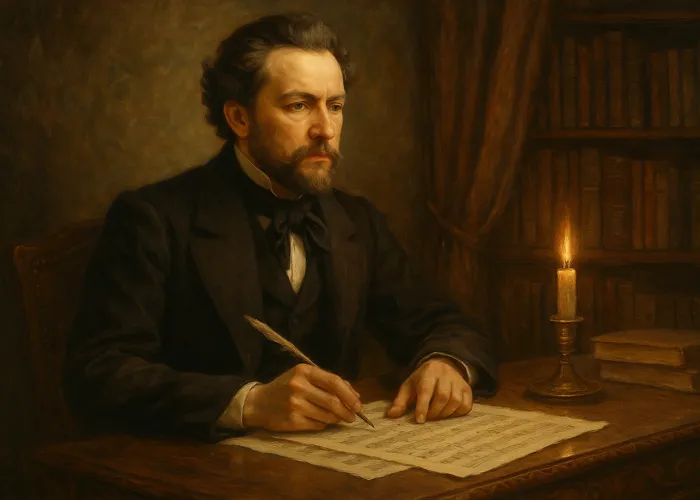
Tchaikovsky's father, Ilya Petrovich Tchaikovsky, was a mining engineer and inspector of a government ironworks. His mother, Alexandra Andreyevna, was of French descent and a significant early musical influence on the young Pyotr. She sang, played the piano, and gave her son his first lessons.
From the earliest age, Pyotr displayed an unusual sensitivity to music. A governess recalled that he would stay awake at night, pressing his hands to his ears and crying that he could not stop hearing music in his head. He began piano lessons at age five and showed rapid progress.
In 1848, the family moved to Saint Petersburg. The following year, a typhoid epidemic struck the household and Tchaikovsky's mother died in 1854 — a loss that devastated him and left emotional wounds that many musicologists trace through his later work.
Tchaikovsky studied at the Imperial School of Jurisprudence in Saint Petersburg from 1850 to 1859, training for a career in government service. The school had musical traditions and a small orchestra, but formal composition training remained out of reach. He worked briefly as a clerk in the Ministry of Justice before making his decisive turn toward music.
Born in Votkinsk, Ural region, Russia, on 7 May.
Begins piano lessons; shows exceptional musical sensitivity from infancy.
Enrolled at the Imperial School of Jurisprudence in Saint Petersburg.
His mother Alexandra dies of cholera. A formative trauma.
Graduates and begins work as a clerk at the Ministry of Justice.
Enrolls in music classes at the Russian Musical Society — the turning point.

Musical Career (1862–1885)
In 1862, the Russian Musical Society's music classes were reorganised as the Saint Petersburg Conservatory under Anton Rubinstein — Russia's first genuine conservatory of music. Tchaikovsky enrolled in the inaugural class, abandoning his government post and accepting a drastically reduced income to study harmony, counterpoint, and composition.
He graduated in 1866 with a silver medal and was immediately recruited by Anton's brother Nikolai Rubinstein to teach harmony at the newly established Moscow Conservatory. He would remain in Moscow for the next twelve years, composing prolifically alongside his teaching duties.
The Moscow Years
The 1860s and 1870s were immensely productive. In Moscow, Tchaikovsky completed his first three symphonies, his first opera (The Voyevoda), the Romeo and Juliet Fantasy Overture (1869 — one of his most celebrated works), and the First Piano Concerto in B-flat minor (1875), which became one of the most frequently performed concertos in the repertoire.
His relationship with the influential critic and composer Mily Balakirev and the nationalist group known as The Mighty Handful was complicated. Tchaikovsky respected Russian musical identity but was equally drawn to the German classical tradition. He steered an independent course.
The Patronage of Nadezhda von Meck
In 1877, Tchaikovsky entered one of the most unusual relationships in musical history: a fourteen-year correspondence and financial patronage with Nadezhda von Meck, a wealthy widow and passionate music lover. On one condition: they would never meet in person.
Von Meck provided Tchaikovsky with a generous annual stipend that freed him from financial worry and from teaching, allowing him to compose without interruption. Their correspondence — over 1,200 letters — is an invaluable document of his artistic and personal life.
Major Works of the Middle Period
Swan Lake
Op. 20 — Ballet (1876). His first full-length ballet, initially unsuccessful at its premiere.
Symphony No. 4
Op. 36 — Dedicated to Von Meck; a statement of fate and struggle (1878).
Eugene Onegin
Op. 24 — Opera after Pushkin, premiered in 1879. His greatest lyric opera.
Violin Concerto
Op. 35 — Composed in 1878, one of the most performed concertos ever written.
1812 Overture
Op. 49 — Composed 1880 for the consecration of a Moscow cathedral.
Serenade for Strings
Op. 48 — One of his most lyrical and beloved chamber orchestral works (1880).
Later Years & Legacy (1885–1893)
From the mid-1880s, Tchaikovsky was an internationally celebrated figure. He conducted his own works across Europe and, in 1891, toured the United States to great acclaim, conducting at the opening concerts of Carnegie Hall in New York. In Russia, he was finally recognised as the nation's foremost composer.
His final years produced some of his greatest works. The ballets Sleeping Beauty (1889) and The Nutcracker (1892) represent the pinnacle of 19th-century ballet music. The opera The Queen of Spades (1890) is widely considered his operatic masterpiece.
His Sixth Symphony, known as the Pathétique (Op. 74), premiered on 28 October 1893 in Saint Petersburg, just nine days before his death. Its unprecedented finale — a slow, fading adagio lamentoso — has long been heard as a musical farewell.
Final Masterworks
- Sleeping Beauty (Op. 66, 1889) — Ballet; often called the greatest ballet score ever written
- The Queen of Spades (Op. 68, 1890) — Opera; his dramatic masterpiece
- The Nutcracker (Op. 71, 1892) — Ballet; the world's most performed ballet
- Symphony No. 6 "Pathétique" (Op. 74, 1893) — His final and most personal symphony
Death and Enduring Legacy
Tchaikovsky died on 6 November 1893, nine days after the premiere of the Sixth Symphony. The cause of death was officially recorded as cholera. He was fifty-three years old.
His legacy is immeasurable. He bridged Russian nationalism and European tradition, elevated ballet music to symphonic seriousness, and wrote melodies that have become part of the fabric of global culture. His influence can be heard in film scores, popular music, and the work of composers from Rachmaninoff to John Williams.
| Legacy Area | Impact |
|---|---|
| Ballet Music | Transformed ballet from incidental entertainment to full symphonic art form |
| Russian Music | Established the international identity of Russian classical music |
| Orchestration | Expanded the expressive palette of the late Romantic orchestra |
| Concerto Form | His concertos remain among the most performed in the world |
| Film & Media | His works are among the most quoted and adapted in the history of film music |
